
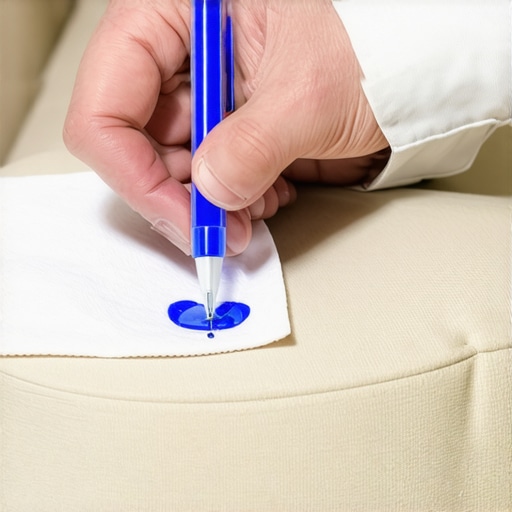
I remember the exact moment my heart dropped into my stomach. I had just finished a deep [house cleaning routine to maintain perfection](https://spotlesscarpetz.com/daily-house-cleaning-routine-to-maintain-perfection) and sat down with a cup of coffee, only to spot it: a jagged, aggressive blue streak across the arm of my cream-colored fabric sofa. My toddler had decided the upholstery was a much better canvas than his coloring book. My first instinct was to grab a wet rag and scrub. Big mistake. Huge. All I did was smear the pigment deeper into the fibers, turning a sharp line into a fuzzy, blue cloud. We have all been there, standing over a piece of furniture we love, feeling like we just ruined it forever. But after years of trial, error, and some genuinely helpful [upholstery cleaning tips for a fresh home revival](https://spotlesscarpetz.com/upholstery-cleaning-tips-for-a-fresh-home-revival), I have learned that a pen mark is not a death sentence for your living room. Today, I am going to walk you through the exact process I use to lift those stubborn ink stains without leaving a ghostly shadow behind. We are going to solve this together, and you won’t even need to call in a professional or hide the spot with a strategically placed throw pillow.
Stop scrubbing before you ruin the fibers
If you are holding a sponge right now, put it down. The single most important thing I learned the hard way is that friction is your enemy when it comes to ballpoint ink. Ballpoint ink is a nasty cocktail of pigments and resins designed to dry fast and stay put. According to the American Cleaning Institute, the most critical step in stain removal is acting quickly without spreading the substance further. When you rub, you are just pushing that oil-based ink deeper into the weave. I once ruined a gorgeous armchair because I thought elbow grease was the solution. It wasn’t. Instead, we need to focus on dissolving the ink and lifting it out. This is especially true if you are dealing with delicate materials; for instance, you have to be incredibly careful about [the one thing you should never do when cleaning a velvet couch](https://spotlesscarpetz.com/the-one-thing-you-should-never-do-when-cleaning-a-velvet-couch) to avoid crushing the pile. Whether you are prepping for a [move-out clean](https://spotlesscarpetz.com/move-out-clean-checklist-to-simplify-your-transition) or just trying to maintain your sanity on a Tuesday, the goal is always the same: preservation.
Is a professional cleaner really the only option?
You might be looking at that ink mark and thinking you need to drop hundreds of dollars on a pro. While I love a good professional deep clean for general maintenance, most ink stains can be handled with stuff you already have in your cabinet if you catch them early enough. Have you ever felt that sheer panic when a pen leaks or a child gets creative on your furniture? Tell me I am not the only one who has considered re-covering a whole sofa over one tiny blue line! I promise, once you understand the chemistry of the ink, the fear disappears. We are going to use targeted [house cleaning strategies for a sparkling home today](https://spotlesscarpetz.com/house-cleaning-strategies-for-a-sparkling-home-today) to tackle this specific mess. Next, we will dive into the specific household liquids that actually break down ballpoint ink without bleaching your fabric.
Test your fabric before you make things worse
Even if you are in a rush because you are following a move-out clean checklist to simplify your transition, you cannot skip the spot test. Every fabric reacts differently to solvents. What works for a polyester blend might cause a permanent ring on silk or linen. Find a hidden area—the underside of a cushion or the back of the skirt—and apply a small drop of your cleaning agent. Wait a full minute and blot it with a white paper towel. If the dye of the fabric transfers to the towel, stop immediately. If the fabric looks unchanged, you are good to go. I learned this the hard way years ago when I tried a DIY mix on a vintage ottoman and ended up with a bleached-out circle that looked like a tiny moon. Now, I always cross-reference my methods with an ultimate upholstery care guide for lasting freshness to ensure the material can handle the treatment.
The simple solvent that dissolves ink on contact
For most ballpoint pens, the secret weapon is 70% to 91% isopropyl alcohol. Think of the alcohol like a liquid key that unlocks the dried resin holding the ink to the fibers. Unlike water, which can leave rings, alcohol evaporates quickly. I once had a client who tried the ‘hairspray trick’ she saw on a viral video. The problem was the hairspray was full of oils and fragrances that left a sticky, yellowed mess on her white sofa. We had to use effective house cleaning secrets from cleaning experts just to get the hairspray out before we could even touch the ink. If you are dealing with leather rather than fabric, the process is slightly different, and you should specifically look at how to remove ink stains from leather without discoloring it to avoid ruining the finish.
Use a clean cloth to pull the pigment away
Once you have your alcohol, dampen a white lint-free cloth—never soak it. If the cloth is dripping, you risk the ink spreading outward into a larger halo. Press the damp cloth firmly onto the ink mark and hold it for five seconds. Do not wiggle your hand. When you lift the cloth, you should see blue or black pigment on it. This is the ‘transfer’ phase. Use a fresh, clean section of the cloth for every single press. If you reuse a dirty spot, you are just stamping the ink back into the furniture. It is a slow, methodical game of patience. It reminds me of the precision needed for other tricky tasks, like the shaving cream trick for removing foundation stains from upholstery; it is all about the technique, not the force.
Rinse the area without soaking the stuffing
After the ink is gone, you need to ‘rinse’ the alcohol out. Use a fresh cloth dampened with plain water and blot the area one last time. This removes any residue that might attract dirt later. If you leave the solvent in the fabric, it can eventually weaken the fibers or cause a ‘ghost’ stain to appear weeks later. If you are doing this as part of a larger cleaning day, you might also want to check out some house cleaning strategies for a sparkling home today to keep the rest of the room looking as good as your newly cleaned sofa. The key is to keep the moisture on the surface and never let it seep into the foam or feathers underneath.
More soap is actually making your house dirtier
Most people believe that if a little detergent works, a lot of it will work wonders. In my years of maintaining fabrics, I have found the opposite to be true. When you over-saturate a stain with soap, you are creating a sticky residue that never fully leaves the fibers. This is exactly why your floors feel sticky even after you finished mopping, and the same logic applies to your sofa. That residue acts like a magnet for dust and pet hair. If you have ever wondered why your carpet is still dirty after you shampooed it, it is likely because the leftover soap is pulling in new grime faster than before. The ‘nuance’ here is that cleaning is a chemical reaction that requires a specific ratio; once that ratio is off, you are just adding to the mess.
Why do those phantom stains keep coming back to haunt you?
Have you ever successfully removed an ink mark, only to have a faint version of it reappear two days later? This is known as ‘wicking.’ When the liquid cleaner reaches the backing of the fabric or the foam underneath, it dissolves the deep-set ink. As the surface dries, the moisture from the padding travels upward to the dry fibers, bringing the dissolved ink back to the surface. To prevent this, you must use as little liquid as possible and dry the area quickly with a fan. This is a common hurdle during a move-out clean where speed is essential but precision is often sacrificed.
The subtle difference between a clean surface and a safe one
There is a massive misconception that ‘clean’ means ‘sanitized.’ In my experience, people often skip the crucial step of dwell time. According to the Centers for Disease Control and Prevention (CDC), sanitizing only works if the surface remains wet with the product for a specific amount of time. If you spray and immediately wipe, you haven’t actually killed the bacteria; you’ve just moved it around. When you are looking for sanitizing secrets for a safer house in 2025, remember that biology takes time. You need effective sanitizing methods for a germ-free home that respect these dwell times, especially on high-touch areas like the arms of a chair where you just removed an ink stain.
Stop treating vinegar like a magic potion
I see it in every DIY group: ‘Just use vinegar!’ While I love natural cleaners, vinegar is an acid that can be incredibly destructive. I have seen beautiful stone side tables etched and ruined because someone used vinegar nearby. There is a very specific reason why vinegar is not always the best choice for granite countertops or delicate upholstery dyes. It can break down the protective sealants or cause certain fabric dyes to bleed. For ink, stick to the solvents we discussed rather than reaching for the salad dressing. Mastering these nuances is the difference between a house that looks clean and a house that is truly preserved for the long haul. Have you ever fallen into this trap of over-cleaning or using the wrong ‘natural’ remedy? Let me know in the comments.
Moving beyond the vinegar myths, let’s talk about the gear that actually saves your furniture from the landfill. I used to think a vacuum was just a vacuum, but after seeing a cheap plastic nozzle snag a loose thread on my linen sofa, I became obsessed with the right tools. I personally swear by a natural horsehair brush attachment. Unlike synthetic bristles that can be abrasive, horsehair is soft enough to groom the fibers without causing pilling. This is a level of detail you won’t find in a generic guide, but it is vital for an ultimate upholstery care guide for lasting freshness. When you are deep cleaning, you also need to be mindful of your equipment; for example, why your vacuum brush roll is ruining your hardwood floors is the same reason it shouldn’t touch your delicate sofa—the mechanical heat and friction can melt or distort synthetic fibers.
How do I maintain my upholstery over time?
Maintenance isn’t about a massive Sunday scrub; it is about micro-habits. I have integrated a daily house cleaning routine to maintain perfection that includes a quick thirty-second lint rolling of the most-used cushions. This prevents skin oils and dust from settling into the weave, which is what eventually turns a small ink stain into a permanent grimy patch. If you are preparing for a transition, these habits are what make move-out cleaning hacks ensure your deposit refund actually work. You can’t fix three years of neglect in one afternoon. I also recommend a monthly ‘rotation’ where you flip your cushions and give them a good fluff; if they’re looking a bit tired, you should learn how to revive your flat couch cushions with this simple technique to keep the silhouette sharp. According to the IICRC S300 Standard for Professional Upholstery Cleaning, improper grooming of the nap after cleaning is one of the most common reasons for fabric ‘shading’ or permanent texture changes.
As we look toward the future, I predict we are going to see a massive shift toward ‘smart’ textiles. We are already seeing nanotechnology-treated fabrics that literally bounce liquid off the surface before it can even touch the fiber. Imagine a world where a leaking ballpoint pen just beads up like water on a waxed car! Until that becomes the standard in every home, we have to rely on precision and the right air quality. Check why your vacuum filter might be making your allergies worse, because fine dust settling on your furniture is the silent killer of fabric vibrance. My best advice? Don’t wait for a disaster. Grab a bottle of 91% isopropyl alcohol and a white cloth, and go test that hidden corner of your sofa right now. Knowing exactly how your fabric reacts today will save you from a heart-dropping panic tomorrow.
What I Learned the Hard Way About Fabric Preservation
One thing I wish someone had told me years ago is that heat is the permanent ‘lock’ for ink. If you try to speed up the drying process with a hairdryer on high heat or, worse, if you use a steam cleaner, you are essentially baking the pigment into the fibers. This is why you should never use a steam cleaner on these specific upholstery fabrics when dealing with oil-based stains like ballpoint ink. I also realized that ‘blotting’ isn’t just a suggestion; it’s a science. If your cloth isn’t white, the alcohol could cause the cloth’s dye to bleed onto your sofa, creating a whole new disaster.
The Items I Keep in My Emergency Cleaning Kit
To keep your home looking its best, you don’t need a massive closet full of chemicals. I personally rely on a few high-quality basics. First, I always have 91% Isopropyl Alcohol on hand—it’s the only thing that truly breaks down the ink resin. Second, a stack of white microfiber cloths is essential for the ‘transfer’ method we discussed. Finally, I never clean without a natural horsehair brush to groom the fabric afterward. #IMAGE_PLACE_HOLDER_E# For a deeper dive into materials, I always refer back to this ultimate upholstery care guide for lasting freshness to ensure I’m using the right approach for every specific textile in my home.
Turning Your Living Room Back Into a Sanctuary
Don’t let a single pen mark steal the joy of your home. Upholstery cleaning might seem intimidating at first, but once you’ve mastered the art of the gentle blot and the right solvent, you’ll feel like a pro. Whether you are performing a regular refresh or following move-out cleaning strategies to secure your deposit, the confidence of knowing you can handle a mess is priceless. If you ever feel stuck or the stain is just too large, don’t hesitate to reach out to us for expert advice. You’ve got this!
Have you ever struggled with a stubborn ink mark that just wouldn’t budge? Let me know your story in the comments below!